Analogue to digital converter ADC
What is ADC (Analog To Digital Converter)?
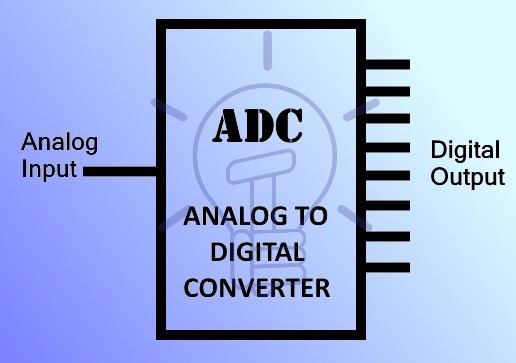
ADC stands for analog to digital converter. It is an electronic device used for converting an analog signal into a digital signal.
Block diagram of ADC
Sample
The sample block function is to sample the input analog signal at a specific time interval. The samples are taken in continuous amplitude & possess real value but they are discrete with respect to time.
The sampling frequency plays important role in the conversion. So it is maintained at a specific rate. The sampling rate is set according to the requirement of the system.
Hold
The second block used in ADC is the ‘Hold’ block. It has no function. It only holds the sample amplitude until the next sample is taken. The hold value remains unchanged till the next sample.
Quantize
This block is used for quantization. It converts the analog or continuous amplitude into discrete amplitude.
The on hold continuous amplitude value in hold block goes through ‘quantize’ block & becomes discrete in amplitude. The signal is now in digital form as it has discrete time & discrete amplitude.
Encoder
The encoder block converts the digital signal into binary form i.e. into bits.
As we know that the digital devices operate on binary signals so it is necessary to convert the digital signal into the binary form using the Encoder.
This is the whole process of converting an Analog signal into digital form using an Analog to Digital Converter. This whole conversion occurs in a microsecond.
Factors Of ADC
Resolution:
Resolution of an ADC is the number of bits that represents the digital signal’s amplitude.
The analog signal has continuous amplitude. It can have infinite values i.e. real, floating basically any value one can imagine. On the other hand, the digital signal has a discrete and finite number of values. These discrete values are represented using binary numbers (bits).
To better understand the idea of resolution of ADC,


Comments
Post a Comment
if you have any doubts,please let me know